Showing posts with label Europe. Show all posts

Thursday, May 24, 2018

Books: Interview with Greek Romance Author Charis Mavros (Χάρης Μαύρος)

Today we have the pleasure of introducing you to Charis Mavros. Find out more about this talented Greek writer in the interview below.

Where are you from and what's your background?

I come from the beautiful city of Thessaloniki, the second largest city in Greece. I could refer to my studies or to various distinctions, but I do not think that these are the ones that define the background of a man, but his family, his friends and his relationships in general. As for the last part, I was fortunate to grow up and be loved by an excellent family and to meet people with a pure soul.

That’s the best background one can have, full of love. When did you realize you wanted to write and when did you start writing?

I started writing when I was a child. The process became more systematic at the age of fourteen as a need for expression and mental decompression, resulting from various difficulties of that period.

Writing is indeed a great form of expressing oneself. What genre do you write and what's your target audience?

I believe that the genre of my books is primarily romance, with some elements of thriller.  I think that genre is not representative of a writer who has too many things to say. Personally, I use it as a vehicle to examine, on a psychological level, social behaviors and the human soul in general. 

Check out his short story Everywhere with you, available in English on amazon:


How many books have you published so far? Have you been published in any other publications or journals?

I have written two books so far, "Up to Four" by Thermaikos publications and "Love is not buried on Tuesdays" by Savvalas publications. My first novel concerns the sexual relationship of four people, two men and two women who simultaneously conclude an erotic quartet. While they are four, they seem to be a simple pair of two.
My second novel is titled "Love is not buried on Tuesdays" and concerns the relationship between a middle-aged woman and a man who is half her age, during the economic crisis in Greece. The story examines how two different generations face the crisis with the background of a karmic, majestic love.

That sounds interesting, and it’s great that you were able to incorporate the contemporary situation of Greece in your writing. Do you have a favorite quote?

I don’t have favorite quotes. Life cannot be defined by a few phrases. Just as a novel consists of many different opinions that many times overturn one another, so is life itself. Moreover, something that is functional for someone may be dysfunctional for someone else.

Good observation. Do you have a favorite author? Has this author or his book(s) influenced your writing in any way?

My favorite author is Doris Lessing. I consider her writing to be special and distinctive. I try not to be influenced by writing styles, but subconsciously the books we admire affect our writing, as all things we love are being absorbed to become part of us.

She’s a great literary influence. If you could be a character from any book, who would you like to be? Why?

No one in particular. I do not envy the lives of others, whether they are real or products of imagination.

What are you working on now?

Having finished my third novel and waiting for it to be released, I have started my fourth novel. It is a novel that will strip off the family institution and Puritanism that still characterizes our society.

Looks like you’re very busy writing and publishing. Where can we find out more about you and your writing? 
 
You can find out about me on my blog “www.onlinegreekbook.wordpress.com”, on my facebook page as Χάρης Μαύρος - Charis Mavros, on my instagram as “charismavros” and you can ask any questions about my books at my email mavroscharis@gmail.com

Is there anything else you'd like to share with our readers?

I would only advise them first to live and then to read.  Thank you.

Thank you so much for your time! We wish you success in your writing career and hope your books will be available in English soon!


Follow Charis Mavros at:


Saturday, August 27, 2016

Books: Interview with expert historian Christopher Berg


We are fortunate to introduce Christopher Berg on the blog today, who is a writer and an expert in History! We invite you to read on to find more about his exciting background and work.

Christopher, can you tell us a little about you?


I’m from the United States and my educational background includes an undergraduate degree in Medieval and Renaissance studies, advanced degrees in Religious studies and Comparative World history, and a doctorate in Curriculum and Teaching.  My teaching includes all areas of history with majors-level courses in modern Europe and military history, as well as the humanities and world religions.

Wow, that's impressive. I love history, too, it can teach us so much. Tell us about your book.


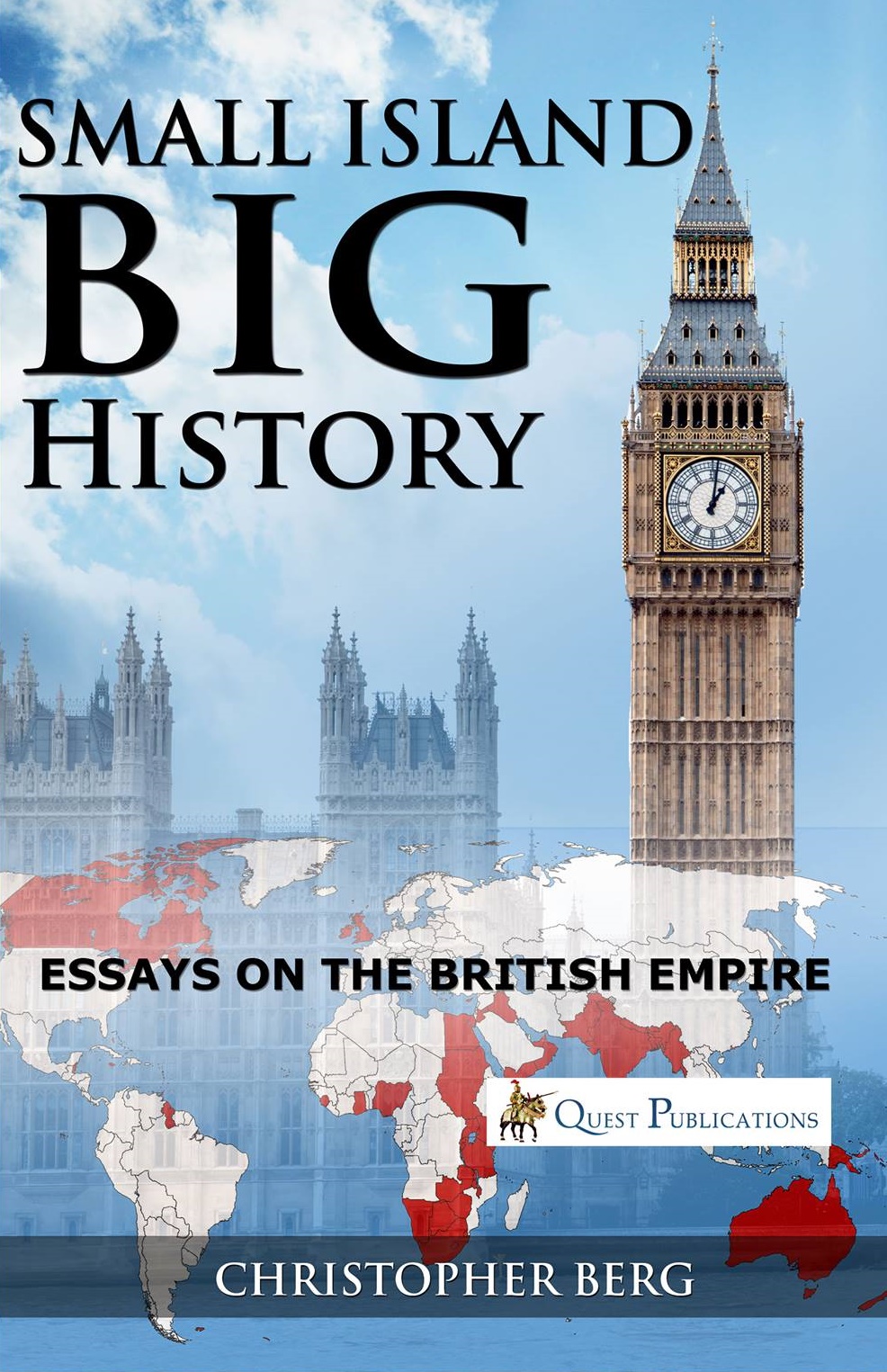
The book is a collection of essays I wrote on various aspects of the British empire. Generally, they look at specific moments in time, such as the creation of the Boy and Girl Scout movements in sub-Saharan Africa, through the lens of “empire” and “imperialism.”


That sounds very interesting and a different look at this time period. What's your target audience?


The book was written as a popular history, so that it would appeal to a wide readership. The narrative resembles more of a story line rather than a dry retelling of events that are standard fare in many historical studies. The content does not presuppose a level of familiarity with the topic; in fact, necessary background information is often woven into each short essay to make the reading more accessible and, perhaps even, enjoyable. This book would make an excellent companion to a majors-level course in British history but would, no doubt, be beneficial to anyone interested in transnational themes, such as international history and the rise and fall of empires.


I'm sure the book is very enjoyable! Why did you choose to write a book with this subject, though?


When I was a graduate student, certain courses were only offered on a rotation basis and one of the courses I had wanted to take for some time was open when my own course load was light, so I took “Great Britain and the British Empire” as one of my exit courses.  It was undoubtedly the most difficult course of my graduate career as the reading and writing loads were unlike anything I had ever taken before. But, this course, and the professor who taught it, pushed the boundaries of what I thought was humanly possible, or even desirable, and it led to a period of intellectual growth I had not experienced since my time at New College. Much of the content for this book was produced, in preliminary form, during this time.


That shows how a teacher can influence learning so much! And now you're spreading your love of history and making it accessible for all. Is there a historian that you think that has influenced you?


Several come to mind but only a few have really influenced my own educational and professional path and the way I see the world. Will Durant, in his Story of Civilization, showed me the lofty heights of good style and prose.  The first volume I ever read of his award-winning multi-volume work was The Renaissance and it profoundly influenced the way I see history and how I try to communicate it in my own writing.  If there is one historian who rivals, or even surpasses, the grand style of Gibbon it would be Durant. Daniel Boorstin’s trilogy on civilization, too, is one of my favorites to read as it blends the best of academic and popular history.  Boorstin’s The Seekers is one of my favorites as it was the first to introduce me to a number of topics outside of Western Civilization as well as cultivate an appreciation for good quotes.  Niall Ferguson is one of the few living historians that continue to influence the way I see the world; his award-winning book The Pity of War was not read once, but twice, as it was on the syllabi of two different courses I took in grad school. Ferguson has become quite an intellectual luminary for his conservative and, often, contrarian positions on economics, history, politics, and the rise and fall of nations. He is particularly relevant today because he uses the past as a measure and standard for the present but also as a means to discern the future. And, if you’ve never seen him speak or debate, I encourage you to do so because you’re promised a stimulating tour de force on the intersection of history and current events.

Thanks for the suggestions. History lovers will be thrilled! What made the British Empire, in your opinion, stop being an Empire?


Winston Churchill’s vision during World War II was to not only survive the war and the Nazi threat, but also to maintain, if possible, the grandeur of the empire. He had grown up during the Victorian age at the height of Britain’s empire and imperial position. But, as an aged prime minister, Churchill saw that the empire had slipped the grasp of the British and in order to make it through this ordeal, they would have to relax their positions towards their colonial brethren. This was especially so in Africa and India. World War II, essentially, brought the end of the British empire and, in the post-war world, a new balance-of-power emerged with new superpowers and a new wave of paranoia in the dawn of the nuclear age. Britain would not play a key role and would be resigned to focusing on social and welfare matters at home. Two world wars had crippled continental Europe and Great Britain; the only vestiges of the empire remaining reside in historical memory and in the title of United Kingdom of Great Britain and Ireland.


I'm learning a lot with this interview! Are there any other subjects that interest you?


Ancient and medieval history, in general, and military history, in particular, are my favorites. One of the problems of attending university in the United States is that you must have a good idea of what you want to study and then specialize and declare majors/minors but I never did so until the last minute when the matter was forced upon me as I just couldn’t bear to pass up a class because it wasn’t in my specialty. I still feel that way, even now. I earned a degree in Comparative World history mainly because the scope of my program was too diverse to “fit” in any other major at my university.  


That's true. There are so many interesting courses to take. What are you working on now?


I’m presently completing my dissertation on World history education in public and private schools and how teachers negotiate historical significance intellectually and instructionally in the classroom. 

I hope you will write more books on history. Where can we find out more about
you and your work? 

My website is christopherberg.org and I have author’s pages at Amazon.com, Ancient History Encyclopedia and Historical Quest online.You can read about my books at www.quest-publications.com

Thank you so much for spending some time here letting us know more about your work and your book! We wish you lots of success and keep making history available to all! 

For more about Christopher's work, and to buy his book, please click below.

http://payhip.com/b/WG57/af59a58b6f2d13f